Atmospheric Plasma Solutions has been selected as a finalist in the 2026 Maritime Manufacturing Innovation Challenge. The final round runs at the Defense TechConnect Innovation Summit at the Gaylord National, National Harbor, Maryland, September 22 through 24: five minutes to pitch, two minutes of questions.
The Challenge is presented by TechConnect and powered by ATI, in collaboration with the National Shipbuilding Research Program, the Defense Industrial Base Consortium, the Undersea Technology Innovation Consortium, the Naval Surface Technology & Innovation Consortium, and EMC². The collaborator list is a large part of why we entered. Those organizations are where naval manufacturing technology actually transitions, and a hearing in front of them is worth more to us than most conference stages.
The Corrosion Problem
The Challenge grew out of the Executive Order to Revitalize U.S. Maritime Power, and its stated targets are lifecycle efficiency, production capacity, and operational readiness. Corrosion sits underneath all three. Department estimates put corrosion-related costs above $21 billion a year, though the version a hull tech recognizes is smaller and more specific: a preservation backlog that grows through a deployment, gets triaged rather than closed out, and waits on a yard period a year away.
Underway, the standard tools remain needle guns, wire wheels, and grinders. They work, after a fashion. Noise and vibration exposure caps how long a sailor can safely run them, and mechanical removal takes base metal along with the coating, a cost the hull pays back later in its life.
What We Built
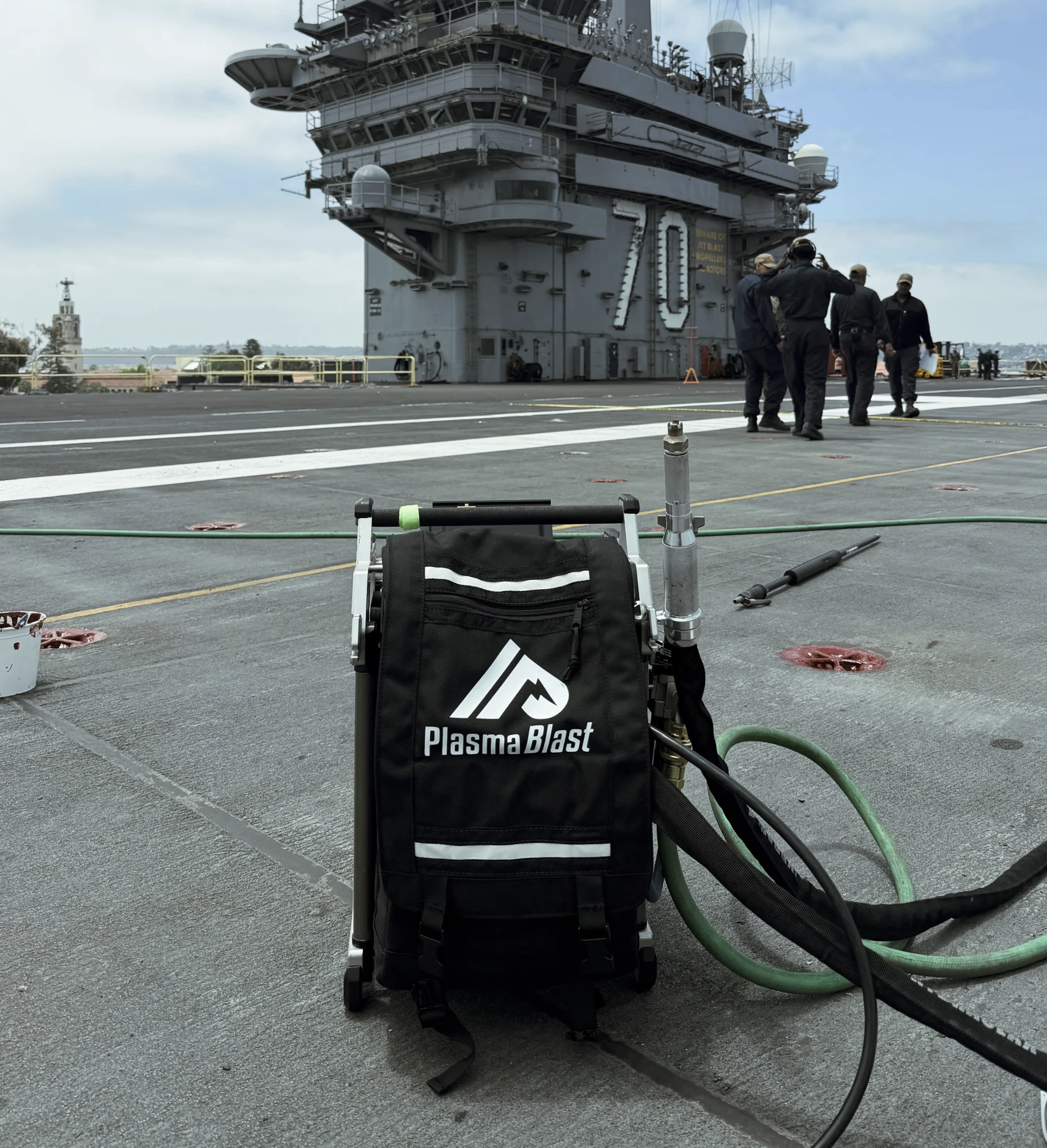
PlasmaBlast is a 40-pound handheld system that runs on 120 to 240V single-phase ship's power and sets up in about five minutes, with no compressed air, blast media, or containment enclosure. The plasma plume strips coating and corrosion and leaves a chemically activated surface ready for the next coat, in a single pass. NAVSEA fatigue testing on HY-80 found no measurable substrate damage.
Most industrial plasma processes run under vacuum, which is why they live inside fabrication shops rather than on hulls. APS spent close to two decades developing an open-air process at higher plasma density, and that work is what lets the same chemistry operate on a weather deck at sea, where the maintenance requirement actually sits.
The Record We Are Bringing
Roughly 120 PlasmaBlast systems have been sold across every branch of the U.S. military, and the system is in active use on at least ten Navy ships. In July 2024, the cognizant NAVSEA Technical Warrant Holder approved unlimited use on all surface ships and aircraft carriers. USS Bainbridge (DDG-96) carried the system through a 326-day deployment. APS holds SBIR Phase III status, a GSA Schedule, an APFIT award, and 40 granted patents across eight countries with 13 more pending.
In July of this year, PlasmaBlast received a National Stock Number, which for readers outside the defense supply system is the quiet item on that list and probably the most consequential. An NSN means a sailor can requisition the tool through normal supply channels against unit-level O&M funds, without a program office standing in the middle of the transaction.
Surface preparation is what we will pitch in September and it is where APS earns its revenue today, though the same open-air chemistry underlies our development work in nitrogen fixation and in PFAS destruction in water. Those programs share the reactor physics, the power electronics, and most of the intellectual property with the tool a sailor holds on deck.
September
Every finalist is paired with a mentor from ATI, and MathWorks is providing software and engineering support to the cohort. Decks are due September 16.
Five minutes forces the argument down to one claim. The maintenance requirement already exists and the fleet is already carrying it. What has been missing is a surface preparation method that works at sea without a shipyard wrapped around it. It exists now and NAVSEA has qualified it. As of July, it also has a stock number.
Our thanks to TechConnect and ATI for the selection. If you will be at National Harbor in September, come find us.
About Atmospheric Plasma Solutions
Founded in 2005 and headquartered in Cary, North Carolina, APS designs and manufactures atmospheric plasma systems for surface preparation and treatment. PlasmaBlast is in service across all branches of the U.S. military and with commercial customers in aerospace, energy, and industrial manufacturing. APS holds NAVSEA Technical Warrant Holder approval, SBIR Phase III status, and GSA Schedule 47QSMS24D00BS.
Learn more about the Challenge: events.techconnect.org/DTCFall/Maritime-Manufacturing-Innovation-Challenge
#DTC26